
How to Hire a Commercial Roofing Contractor in Tampa Bay
How to hire a commercial roofing contractor in Tampa Bay: check the license, insurance, references, proposal and warranty. Call (813) 497-4428.

Adrian Coastal Roofing

To hire a commercial roofing contractor in Tampa Bay, check four things before you compare prices: the state license, proof of insurance, references on roofs like yours, and a written proposal with clear warranty terms. Price comes last, because a low bid from a contractor who is unlicensed or uninsured can leave the building owner holding the risk. This guide is written for owners and property managers, and it is general information, not legal advice. It builds on our commercial roofing services in Tampa Bay guide. Homeowners should read how to choose a roofing contractor in Tampa Bay instead.
Commercial Roofing Contractor License in Florida: What to Verify
Florida treats roofing as a licensed trade. Section 489.105(3)(e) of the Florida Statutes defines a roofing contractor as one whose services are unlimited in the roofing trade. A certified contractor may work anywhere in the state, while a registered contractor may work only in the jurisdictions where that registration was issued. Any commercial roofing contractor in Tampa Bay should give you a license number you can check yourself.
The Department of Business and Professional Regulation (DBPR) says each construction business must be qualified by a licensed individual. It advises searching the business name on MyFloridaLicense.com first, then the individual's name, to confirm the right person qualifies that business. Read the DBPR search steps and note the license type, status and business name. Under section 489.128, a business with no qualifying agent for the work is treated as unlicensed, and an unlicensed contractor cannot enforce its contract.
Commercial Roofing Contractor Insurance and Workers' Compensation
Ask for current certificates for both general liability and workers' compensation, and confirm the dates cover the whole job. NRCA's low-slope contractor guidance says to insist on certificates for both coverages and warns that, if a contractor is not properly insured, the owner may be liable for accidents on the property.
Florida adds a legal layer. Section 440.10 requires a contractor in private construction to secure workers' compensation for its employees, and to require evidence of coverage from its subcontractors. Ask who will actually be on your roof, employees or subcontractors, and request proof for each. Then check the certificate yourself: the state's workers' compensation coverage portal has a Proof of Coverage search and an Exemption search. Required limits depend on your lease, lender and insurer, so confirm them with your agent before bids arrive.
Commercial Roofing Contractor References in Tampa Bay That Match Your Roof
A reference helps only if it resembles your project. NRCA's selecting a contractor guidelines say a contractor should readily offer client references and a list of completed projects, and suggest calling those clients to ask whether they were satisfied with the work. For a commercial building, ask for references on the same roof system, a similar size and a similar use, such as occupied retail or office space. Ask each reference how leaks, delays and cleanup were handled.
NRCA's low-slope guidance also suggests asking which roofing manufacturers the firm has licensed or approved applicator agreements with, because some materials need special application expertise. Request those agreements in writing instead of trusting a logo on a truck. If your roof is a single-ply membrane, our TPO vs PVC vs EPDM comparison will help you ask sharper questions about seams and repairs.
Commercial Roofing Proposal Checklist: What the Bid Must Say
Insist on a written proposal. NRCA says it should contain complete descriptions of the work and specifications, approximate starting and completion dates, payment procedures, and issues such as debris cleanup and landscape damage prevention. For an occupied building, also ask for the tenant and customer access plan, the work hours, and how the crew will protect entrances and loading areas.
When you request bids from a commercial roofing contractor in Tampa Bay, give every bidder the same scope, so you compare like with like. Our commercial roof replacement cost guide shows how to ask for itemized lines. If you have not yet decided between a patch and a new roof, start with our repair or replace framework. NRCA also advises healthy skepticism about the lowest bid, since price is only one criterion.
Commercial Roof Warranty: Workmanship vs Manufacturer Coverage
NRCA describes two basic categories of roofing warranties: the contractor's warranty, which covers workmanship, and the manufacturer's warranty, which covers materials at a minimum. It warns that a manufacturer's warranty alone will not protect you if the roof system is improperly installed. Ask for both in writing, with the start date, the name of who honors each one, and the conditions that void it.
Warranty terms vary by manufacturer and roof system, so read the actual document, not the sales summary. NRCA notes that periodic maintenance inspections help confirm a project meets the standards specified in the warranty, so keep inspection reports and repair invoices in one building file. Our commercial roof maintenance plan guide lays out a schedule and the records worth keeping.
Safety Program and Site Control on a Commercial Roof
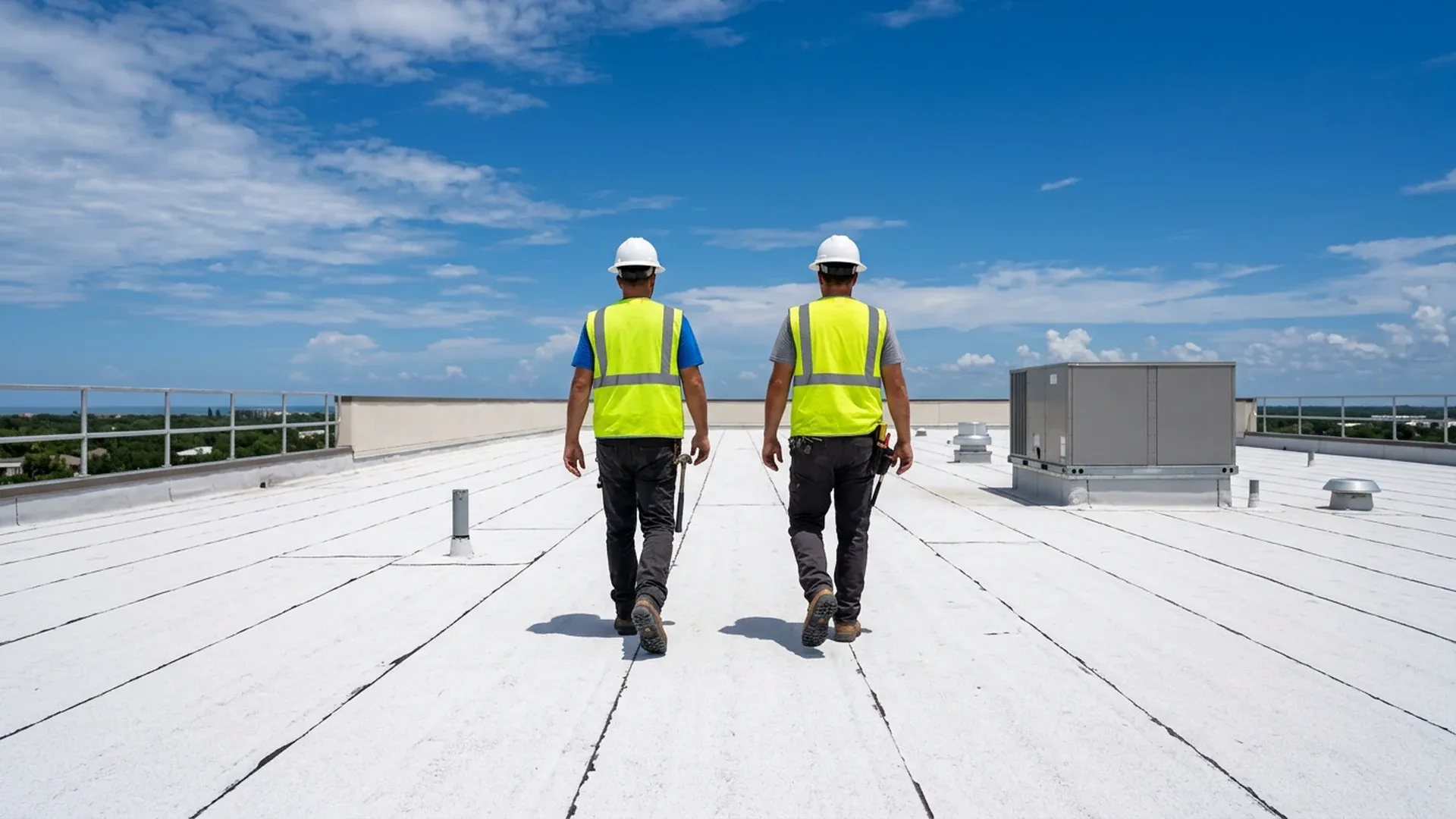
For a commercial roofing contractor in Tampa Bay, a safety program is a hiring criterion, not a formality. NRCA suggests asking what safety training a contractor provides and which industry programs its workers have attended. OSHA's fall protection rule for roofing work on low-slope roofs, 29 CFR 1926.501(b)(10), covers employees working where an unprotected side or edge is 6 feet or more above a lower level. It lists guardrails, safety nets, personal fall arrest systems, or a warning line combined with another method.
Ask each bidder to describe, for your building, how edges and openings will be protected and who is in charge each day. NRCA also suggests requesting the name of the person overseeing the project and how many workers will be on site. Add one question about the ground: how will tenants, customers and delivery traffic be kept clear while work happens overhead?
Closeout Paperwork, Final Payment and Lien Protection
Your choice of commercial roofing contractor in Tampa Bay matters most at the end of the job. Under section 713.06, when final payment is due the contractor must give the owner a final payment affidavit stating whether the lienors who served a timely notice have been paid, and the owner is to retain final payment until that affidavit is delivered. The statute's notice to owner warns that unpaid subcontractors and suppliers may look to the property for payment even if the contractor was paid in full, and tells owners to obtain a written release each time they pay.
Ask the contract to list what you will receive at closeout: the affidavit, releases, written warranties, final inspection sign-off and photos of the finished work. Lien law is technical, so have your attorney review the contract and payment schedule.
Tampa Bay Commercial Roofing Contractor FAQ
How do I shortlist a commercial roofing contractor in Tampa Bay?
Verify each license on MyFloridaLicense.com, confirm workers' compensation and liability certificates, and call references on roofs like yours. NRCA recommends prequalifying contractors. Then request written proposals from two or three firms on the same scope, and compare them line by line before you look at price.
Is a certificate of insurance enough proof of coverage?
A certificate is a starting point, not the finish. Check that the policy dates cover the whole job, then look the employer up in the Florida Division of Workers' Compensation Proof of Coverage search. Ask for updated certificates if the job runs long, and ask for evidence of coverage from every subcontractor.
Does every commercial roofing job need a licensed roofer?
Florida licenses roofing contractors under Chapter 489, which also lists limited exemptions in section 489.103. Exemptions depend on the facts of the job. Ask the contractor to state its license number in the proposal, and confirm unusual cases with DBPR or your local building department.
Request a Commercial Roof Evaluation From Coastal Roofing Group
Looking for a commercial roofing contractor in Tampa Bay who can answer every question above? Coastal Roofing Group is a family-owned, licensed and insured contractor with a BBB A rating. Since 1993 we have worked on roofs across Tampa Bay and Central Florida, and we back commercial jobs with a written workmanship warranty and qualifying manufacturer material warranty. Bring this checklist and call (813) 497-4428 to talk through commercial roof repairs and installation for your building.
About Adrian Coastal Roofing
Adrian is the CEO of Coastal Roofing, a company specializing in roof installation in Florida, recognized for its quality, reliability, and excellence in residential and commercial projects. With years of experience in the construction industry and Florida roofing, Adrian has built his reputation by delivering durable solutions that withstand the state’s extreme weather. Under his leadership, Coastal Roofing has become a leader in roof installation in Florida, offering modern systems such as TPO, PVC, metal roofing, and other efficient solutions to reduce costs and extend the lifespan of roofs.


