
Standing Seam vs Exposed Fastener Metal Roofing in Florida
Standing seam vs exposed fastener metal roofing in Florida: slope, upkeep, wind approvals and fit. Free estimates from Coastal Roofing Group, (813) 497-4428.

Adrian Coastal Roofing

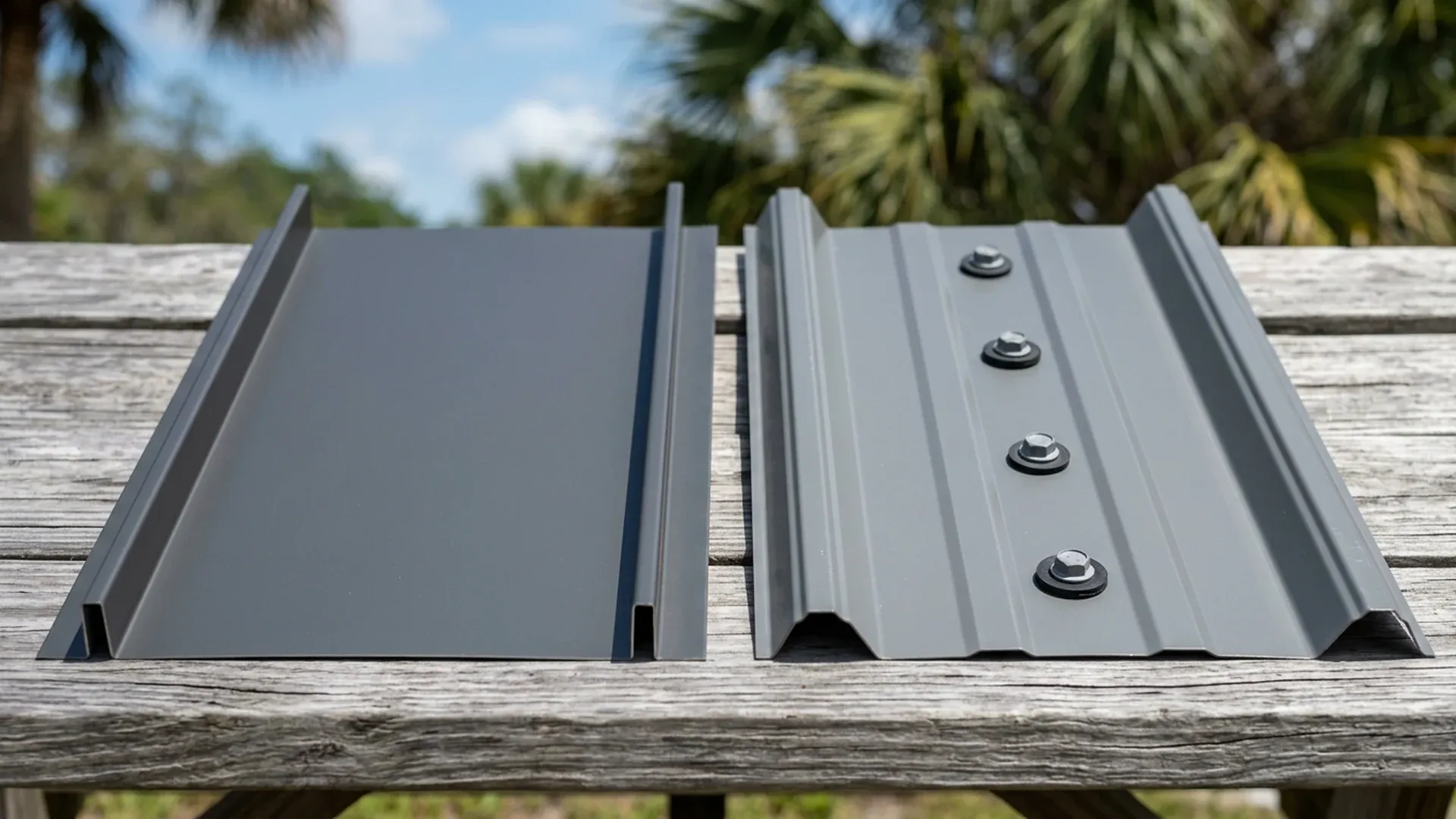
Standing seam vs exposed fastener comes down to one physical difference: where the screws go. A standing seam roof holds its panels with concealed clips under raised, interlocking seams. An exposed fastener roof drives gasketed screws straight through the face of each panel. Neither is wrong for every building, so the right pick for a Florida roof depends on slope, roof shape, upkeep and how long you plan to own the property.
This guide compares standing seam vs exposed fastener metal roofing on the points that change the decision in Tampa Bay: slope limits in the Florida Building Code, thermal movement, maintenance, wind approvals and salt air. For what we install, see our guide to metal roofing services in Tampa Bay. If you are still choosing a contractor, our Riverview metal roof contractor guide covers that side.
Standing Seam vs Exposed Fastener: How Each Panel Is Held Down
Standing seam panels run from ridge to eave with raised vertical legs. The legs lock together, either snapped or folded closed with a seaming tool, and clips under the seam fasten the panel to the deck. The fasteners never touch the weather. Exposed fastener panels, sold as R-panel, PBR, 5V crimp or corrugated, overlap at the edges and are screwed through the flat of the panel, so every screw head and its washer sits on the surface.
Sheffield Metals, a metal coil supplier, defines standing seam as a concealed fastener system and exposed fastener as one fastened through the face of the metal. That single difference explains most of what follows: the number of roof penetrations, how the panel moves, what upkeep it needs and what it costs.
Metal Roof Minimum Slope for Each Panel Type
In a standing seam vs exposed fastener decision, slope often settles the question before style does. Section R905.10.2 of the 2023 Florida Building Code, Residential, sets minimum slopes for metal roof panels. Lapped, nonsoldered-seam metal roofs without applied lap sealant need at least 3 units vertical in 12 horizontal. With applied lap sealant, the minimum is one-half unit in 12. Standing seam roof systems may go as low as one-quarter unit in 12. We checked this section in October 2026.
Those are code floors, not product promises. Sheffield Metals calls 3:12 the industry standard minimum for exposed fastener systems and says snap-lock standing seam should not go below 3:12, while mechanically seamed profiles can go lower. Follow the installation instructions for the exact panel, and ask your building department about local rules. A low-slope porch or addition can narrow your choices.
How Thermal Movement Affects Fasteners and Seams
Metal expands and contracts as temperatures change, and the attachment method decides where that movement goes. Sheffield Metals explains that restricting a panel's movement can cause oil canning, fastener withdrawal and extra noise. On standing seam roofs installed to its recommended details, panels are not double pinned, so clips and snap-lock legs let them move.
An exposed fastener panel is screwed down at many points along its length, so each heating and cooling cycle works against the screws. That is how fasteners can back out over time. Panel maker McElroy Metal draws the same line: standing seam clips let the panel float, while exposed fastener panels attach through the face of the metal. Tampa Bay sun repeats that cycle daily.
Exposed Fastener Metal Roof Maintenance vs Standing Seam Upkeep
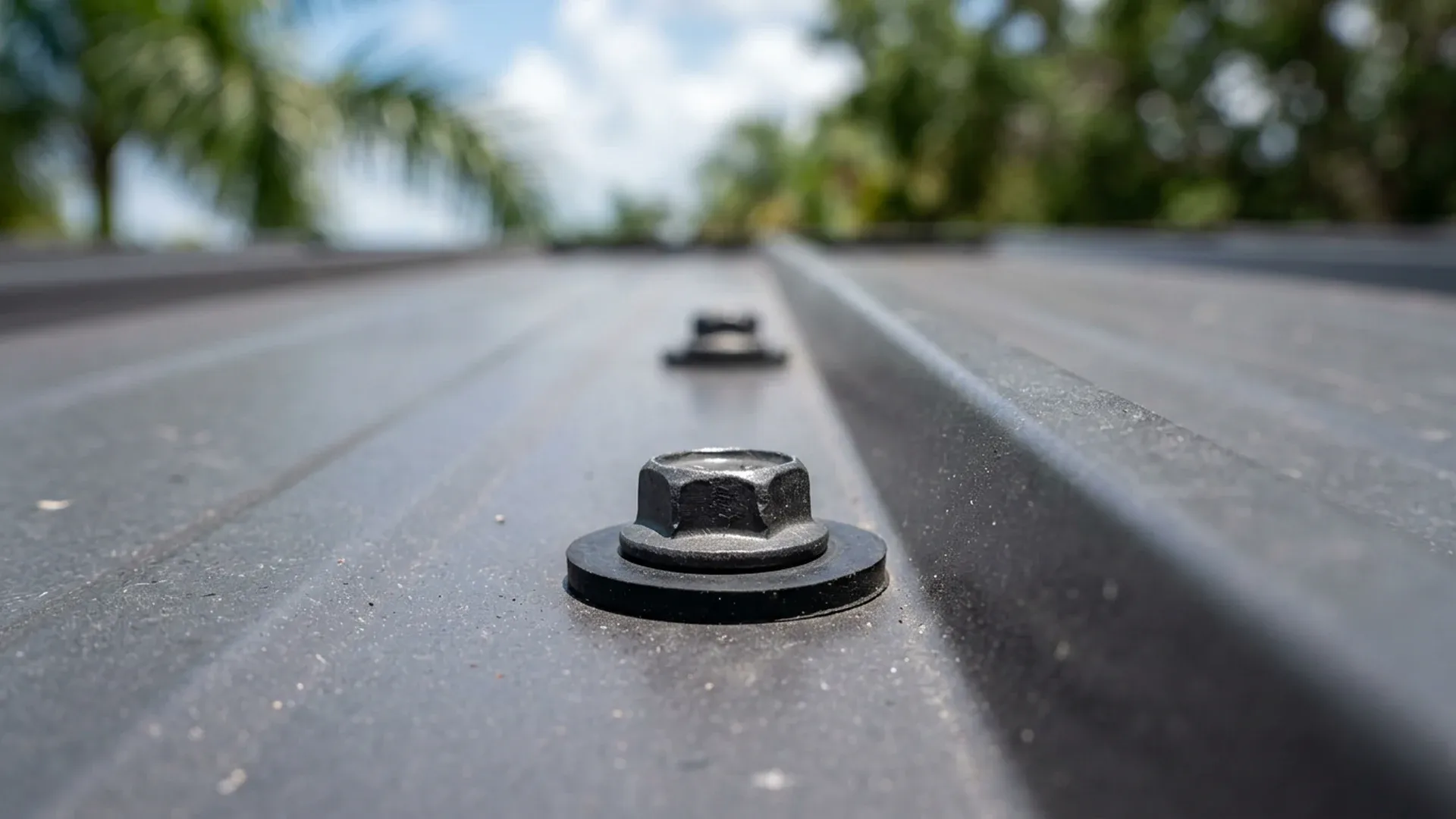
Every metal roof needs maintenance, but the tasks differ. Sheffield Metals' maintenance guide says exposed fastener roofs should have their fasteners checked annually because they can back out, and that the EPDM washer under a gasket head screw can degrade from UV exposure, creating a potential leak point. It also says roofs in places like Florida, or under trees, may need surface maintenance more than once a year. Overdriven, underdriven or angled screws are installation errors that add leak paths too.
A standing seam roof takes face fasteners off that checklist, but not the work. Flashings, penetrations, seams, gutters and valley debris still need attention, and Sheffield notes a single damaged panel can be harder to replace because neighboring panels must be separated. Our guide to metal roof repair in Clearwater covers failing gasket screws, and our metal roof repair service page explains how to request an inspection.
Wind Ratings, Product Approval and Metal Roof Fasteners in Salt Air
In standing seam vs exposed fastener comparisons, panel type alone does not decide wind performance. Section R905.10 of the 2023 Florida Building Code, Residential, requires metal roof panels to be made according to their product approval specifications and limitations of use, and R905.10.4 says panels must be secured to the supports under the manufacturer's installation instructions. Sheffield Metals adds that most exposed fastener systems are not engineered to the same standards as standing seam, so you should confirm the product has testing for your building type and location.
Ask for the approval number of the exact panel and attachment you are quoted. Our metal roof hurricane wind rating guide explains how to read it. Salt air matters for fasteners too. Where manufacturer instructions are silent, R905.10.4 calls for galvanized fasteners on steel roofs and accepts stainless steel.
When Exposed Fastener Metal Roofing Makes Sense
Exposed fastener panels are a legitimate product, not a shortcut. McElroy Metal, which makes both systems, says neither is inherently better and that the answer depends on slope, panel length, budget, building geometry, approval requirements and how the building will be used. Sheffield Metals lists lower price as the main advantage, explained by wider panels, thinner gauge metal, simpler paint systems and fewer accessories.
For an agricultural, post-frame or utility building, or a simple roof where upfront budget leads, exposed fastener can fit, provided the slope meets the manufacturer minimum and someone commits to annual fastener checks. We cannot quote a price in an article, because it depends on roof size, metal and details. Our Brandon article on whether metal roofing is worth the cost shows what moves an estimate.
When a Standing Seam Metal Roof Earns Its Higher Price
Standing seam usually costs more up front, and Sheffield Metals names higher material and labor as its main drawback. The extra buys concealed fasteners, panels that move with temperature, and a profile suited to roofs with many planes. It also lets the code floor drop to one-quarter unit in 12, and it suits owners who want longer gaps between fastener checks.
Weigh the tradeoffs honestly. Sheffield lists fewer qualified installers, a more labor-intensive process and harder single-panel repairs. If your house is a long-term hold with valleys, dormers or a lower-slope section, standing seam deserves a serious quote. If the roof is simple and the budget is tight, ask for a standing seam vs exposed fastener quote in writing. Our pros and cons of metal roofing in Florida gives the wider picture.
Questions to Ask Before Choosing Standing Seam vs Exposed Fastener
Use these questions with any contractor, including us, before you sign.
- What is the slope of each roof section, and what is the manufacturer's minimum slope for this panel?
- Which Florida Product Approval or Miami-Dade NOA covers this exact panel, clip and fastener?
- What fastener metal and washer will be used, and is it suited to salt air?
- Who will inspect and replace gasket screws, and how often should that happen?
- If one panel is damaged, how is a single panel replaced?
- Will the work be permitted and inspected by my local building department?
- What do the workmanship and manufacturer warranties cover, in writing?
Standing Seam vs Exposed Fastener FAQ
Is standing seam always better than exposed fastener?
No. Standing seam hides its fasteners and lets panels move, which reduces fastener upkeep, but it costs more and needs a skilled installer. Exposed fastener can suit simple roofs and tight budgets if the slope is high enough and the screws are checked every year. Fit to the building matters more than a blanket rule.
Can an exposed fastener roof handle Florida hurricanes?
It can if the exact panel and attachment have a valid product approval and are installed to it. No metal roof is hurricane-proof. Ask for the approval number and confirm it with your building department. The installation, decking and fasteners matter as much as the panel itself.
Do exposed fasteners rust in coastal Florida?
Poor fasteners can. Carbon steel screws corrode faster near salt water, which is why Sheffield Metals recommends stainless steel in coastal settings, and the Florida Building Code lists galvanized or stainless fasteners for steel roofs when instructions are silent. Washers also age in the sun, so inspect them every year.
Request a Free Metal Roof Estimate in Tampa Bay
If you are weighing standing seam vs exposed fastener for your home, Coastal Roofing Group offers free estimates. We are licensed and insured, and we install and repair metal roofing across Tampa Bay. Call us at (813) 497-4428, or learn more about our metal roof installation and metal roofing in Florida services.
About Adrian Coastal Roofing
Adrian is the CEO of Coastal Roofing, a company specializing in roof installation in Florida, recognized for its quality, reliability, and excellence in residential and commercial projects. With years of experience in the construction industry and Florida roofing, Adrian has built his reputation by delivering durable solutions that withstand the state’s extreme weather. Under his leadership, Coastal Roofing has become a leader in roof installation in Florida, offering modern systems such as TPO, PVC, metal roofing, and other efficient solutions to reduce costs and extend the lifespan of roofs.


